


Keeping your guests’ education rating high in Planet Zoo can be one of the trickier parts of running a successful zoo, especially in scenarios and challenges that require a certain education score before you can progress.
Luckily, there are far more ways to educate your guests than simply dropping a board beside every habitat and hoping for the best. Education can come from boards, speakers, Audio Guides, Animal Talks, Guided Tours, conservation displays, interactive stations, Educators, and even the research your vets are carrying out behind the scenes.
It is worth putting the effort in, too. Better educated guests are not only useful for completing objectives and improving your zoo rating; the higher a guest’s education, the bigger the bonus to their spending, so a well-educated zoo can benefit your finances as well.
How Education Works in Planet Zoo
Before looking at all the different ways to increase education, there is one important mechanic to understand: a guest cannot become fully educated by repeatedly learning about the same animal.
Guests need to learn about multiple species during their visit. Veterinary research also affects how much they can learn about each species, so a fully researched animal has much more educational potential than one you have barely researched.
That means the strongest education setup combines variety and research. Filling one lion habitat with ten Education Boards will not replace giving guests opportunities to learn about lions, zebras, giraffes, elephants, reptiles, and other species as they make their way around the zoo.
The same principle applies throughout this guide. You want education available where guests will realistically encounter it, but simply placing more objects is not always the answer.
How to Check Your Education Rating
Before adding more equipment, check what is actually going wrong.
Open Zoo Management and head to the Education section. This gives you much more useful information than the overall education score alone. You can check average guest education, see which species guests are learning about, compare education performance between animals, monitor Audio Guide use, check your research progress, and see how your conservation education is performing.
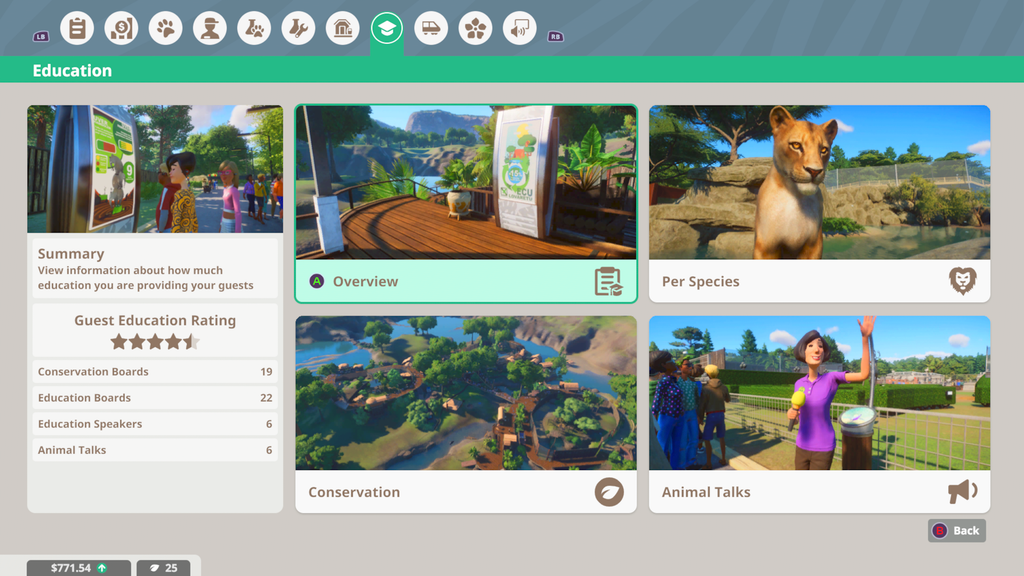
If one animal has excellent education performance while another is barely registering, you immediately know where to investigate rather than adding more equipment everywhere.
Use the Education Heatmap
The Education Heatmap is one of the best tools for diagnosing problems around the zoo.
Blue shows correctly functioning education equipment and, for speakers, its active coverage.
Yellow means an education item needs attention. This includes equipment that has not yet been assigned to a species and items that are not correctly positioned in relation to their target animal.
Black indicates equipment that is not receiving power.
Speaker conflicts are particularly important. While placing or adjusting Education Speakers, conflicting coverage can show as a red section where incompatible speaker ranges overlap. In the Education Heatmap, guests affected by conflicting speakers can also appear red.
Those guests become confused, unhappy, and don’t receive the intended education boost, so red speaker conflicts are worth fixing immediately.
Where to Find Education Items in Planet Zoo
Most of the equipment you need can be found under Facilities > Media Devices and Education.
Be careful with the name of that menu, though. Not everything inside it actually increases education. It also contains screens, cameras, Vista Points, and other media devices that serve completely different purposes.
The functional education items are the ones we are interested in here.
Every Way to Increase Education in Planet Zoo
Ironically, Planet Zoo doesn’t really do much to educate its players about ways to educate their guests. Thankfully, there are plenty of ways to make sure your guests leave your zoo feeling happy and educated.
Education Boards
Education Boards are the obvious place to start. They are inexpensive, easy to use, and useful throughout the zoo, and of course education is literally in their name.
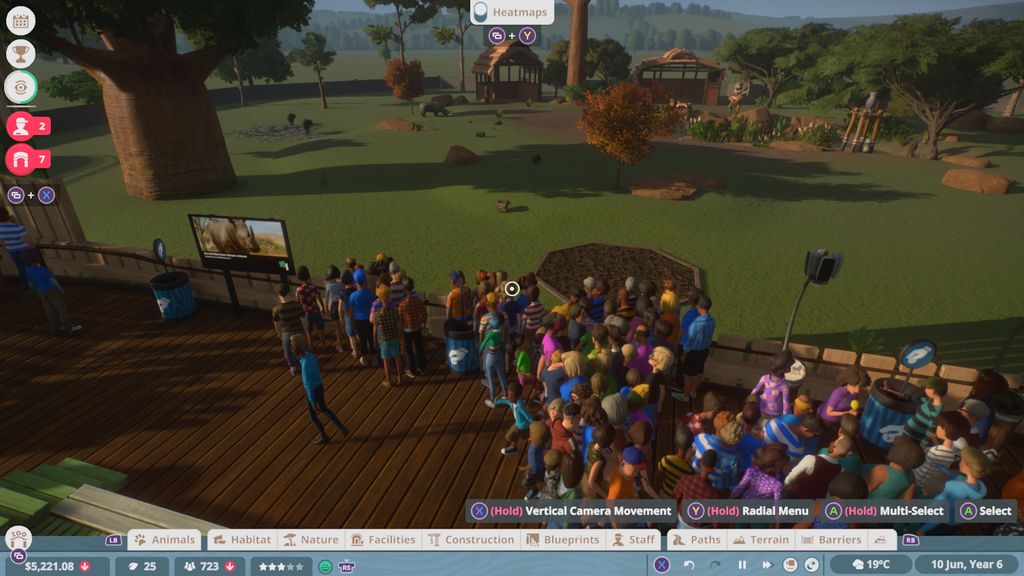
Assign the correct species, make sure the board has power, and place it close enough to the animal it is describing. Guests need to stop and interact with the board, so positioning one beside a genuine viewing area is much more useful than hiding it somewhere guests simply walk past. And, if you can get them to stop long enough to look at the board, they might just make a donation, so make sure to place a donation bin nearby to raise some money for your zoo.
You can also build Education Boards into walls, custom displays, shelters, and scenery if the standard design does not suit the look of your zoo.
There is no need to cover a habitat in identical boards. Multiple boards teaching the same species don’t allow one guest to learn endlessly from that animal. Their main purpose is accessibility. If a habitat has two busy viewing areas on opposite sides, putting a board at each makes sense because different guests may use each viewing point.
Exhibit Education Boards
Exhibit Education Boards work in much the same way. Assign the correct exhibit species, keep the board powered, and place it close enough to the exhibit.
Exhibits are easy to overlook because they take up very little space compared with full habitats, but every exhibit species gives guests another opportunity to learn about something different. In a zoo where variety matters, that makes them worth including in your education setup.
Education Speakers
Education Speakers are one of the most useful ways to raise education because guests don’t need to deliberately interact with them. They automatically receive education while spending enough time inside the speaker’s range.
Select a speaker to adjust its radius and use that coverage to target the areas guests actually occupy. Viewing platforms, benches, busy paths, and places where guests stop to watch animals are ideal.
Don’t automatically turn every speaker up to its maximum range. Guests need to remain within the radius long enough to receive the full benefit, so carefully covering a busy viewing area can be more useful than creating an enormous circle that guests only skim for a few seconds.
More importantly, don’t overlap Education Speakers teaching different species. Conflicting speaker coverage confuses guests and prevents them from receiving the intended education boost. Overlapping an Education Speaker with an Education Board is completely fine. The problem is conflicting speaker audio.
Speakers also need to remain reasonably close to the species they are describing. If the target animal is too far away, the educational value falls, and speakers placed far enough from the relevant species can also negatively affect guest happiness.
Audio Guides
Audio Guides are easy to forget because you do not physically place them around the zoo. They are sold through Information Centres.
Once a guest has one, it can educate them about different species as they travel around habitats and exhibits. This makes Audio Guides particularly useful because one purchase continues providing opportunities for education throughout the guest’s visit.
If your priority is education rather than squeezing as much profit as possible from the guide itself, consider lowering the price. More purchases mean more guests carrying a passive education source around the zoo.
You can check Audio Guide performance from the Education management screen, including how many have been sold and how effectively guests are using them.
Animal Talks
Animal Talks are one of the strongest individual education sources available. Frontier describes them as providing a large education boost to guests who attend.
Place an Animal Talk Point beside a habitat or exhibit, assign the relevant species, and choose the month in which the talk will take place. You will also need an Educator available to deliver it.
If you use several Animal Talks, spread them across the calendar and think about the distance your Educators need to travel. Scheduling multiple talks that one staff member cannot realistically reach is not going to end well.
A standard Animal Talk Point supports up to 50 guests. Animal Talk Seating can increase capacity and gives attending guests somewhere dedicated to sit, but the seating is optional and takes up considerably more room.
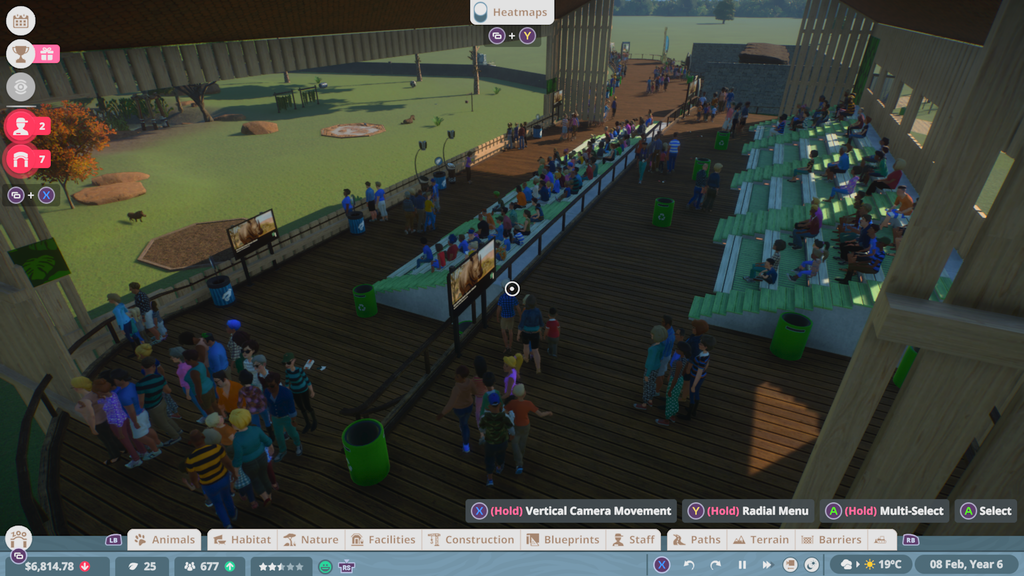
Some species also allow Educators to interact with or demonstrate the animal during a talk. For habitat animals, certain species allow food to be thrown into the enclosure if the Talk Point is positioned correctly. Some exhibit species can also be physically presented by the Educator.
Scenery and feeding can improve the overall quality of the experience, but they should not be treated as separate education multipliers. The main educational benefit comes from the Animal Talk itself.
Train Your Educators
Educator training is worth investing in, particularly if you use Animal Talks, Roaming Talks, or Guided Tours heavily.
Higher training improves staff efficiency, while Educator level directly matters to some of their education activities, including Roaming Talks and the Educator Skill component of Guided Tours.
Guided Zoo Tours
Guided Tours can provide guests with more in-depth education, but they require considerably more setup than most other methods.
An Educator leads a group between Tour Points, stopping at educational points along the way. Place and assign the points you want to use, then open the Tour Manager and arrange them in the order guests should visit.
You do not need to include every animal in the zoo. In fact, smaller themed tours are much easier to operate successfully than a gigantic tour trying to visit everything.
Education Stations
Education Stations provide smaller general education boosts and are useful for filling spaces that are not directly connected to a habitat.
There are Sound, Pawprint, and Height Education Stations. Guest groups containing children can stop and interact with them, and when they do, the whole group receives a small education and happiness boost.
They are particularly useful in family areas, plazas, rest areas, and other spaces where an animal-specific board or speaker would not make sense. You can also customize their colors to better fit your zoo.
Conservation Education Boards
Conservation Education Boards teach guests about broader conservation subjects rather than one particular animal.
They don’t need to be beside a habitat, and their effectiveness is not tied to veterinary research, which makes them useful for entrances, food courts, connecting paths, plazas, and other spaces between animal areas.
Use different conservation topics around the zoo rather than repeating the same message everywhere. There are plenty to choose from, and variety gives guests more opportunities to encounter something new.
Roaming Educators
Educators can provide education even when they are not running a scheduled Animal Talk or Guided Tour.
Idle Educators can perform Roaming Talks around the zoo, giving nearby guests a small education and happiness boost. The effect is smaller than a scheduled Animal Talk, so I would treat this as a useful background bonus rather than the foundation of your education strategy.
Vet Research and Staff Training
It’s not just guests that can benefit from education. Educate your staff with some extra training and the benefits can quickly pay off for your guests education rating too.
Veterinary Research
species. That means Education Boards, speakers, Audio Guides, and other animal education sources become much more useful as your research progresses.
If your zoo is covered in education equipment but most of your animals have barely been researched, you are leaving a lot of potential unused.
Start research early. Because guests need education from multiple species, I prefer to build a reasonable research baseline across the zoo before concentrating entirely on maxing one or two animals. Once you have that foundation, prioritize fully researching popular species, animals used in talks and tours, and species that most visitors are likely to encounter.
Eventually, of course, the best result is to fully research everything.
Train Your Vets
Training vets makes them more efficient and allows them to complete research more quickly.
It does not make the finished research level more powerful. Level 5 research provides the same education benefit regardless of whether a one-star or five-star vet completed it. The trained vet simply gets you there faster.
Research Centre placement matters too. Vets need to move between the animal they are researching and the research facility, so enormous travel distances can waste a surprising amount of time.

Once normal research for a species has been completed, vets can continue with Advanced Research.
Advanced Research contributes to your overall zoo education, making it useful once your standard research is already in good shape. I would not prioritize it while large numbers of animals are still sitting at very low normal research levels.
Staff Rooms Can Help
Staff Rooms do not directly increase guest education, but their bonuses can help the staff responsible for providing it.
Learning Resources help staff train faster, making it useful while you are developing Vets and Educators. Once those employees are already well trained, Rec Room can be useful for faster energy recovery so they spend less time resting and more time researching, touring, or giving talks.
For Guided Tours in particular, putting a Staff Room near an Intermission Point can save an Educator from wandering halfway across the zoo when they need a break.
What Can Stop Education From Working?
Once you have all the major education methods in place, most remaining problems are caused by something preventing them from functioning properly.
The most serious problem is conflicting Education Speakers. If speakers teaching different species overlap, guests in the affected area become confused and do not receive the intended education benefit.
Also check that boards and speakers are assigned correctly, close enough to their target species, and still appropriate if you have moved animals between habitats. Use the Education Heatmap regularly, especially after redesigning part of the zoo.

Power is another simple thing to overlook. Unpowered equipment cannot do its job, while damaged or vandalized education equipment may need attention from your Mechanics.
Animal Talks can also fail if an Educator cannot reach the Talk Point in time. Long distances, poor work zones, low energy, and overloaded staff schedules can all cause problems.
Finally, remember that education changes over the course of a guest’s visit. Improving your setup will not immediately transform the education level of somebody who has already walked past most of your zoo and is heading for the exit. Give the system time to work on guests who actually move through the improved areas.
Things That Do Not Increase Education
The Media Devices and Education menu contains several objects that look as though they should help with education but actually serve another purpose. Custom screens and billboards can display animal images or educational-looking graphics, but they do not replace functional Education Boards.
Habitat Webcams increase marketing rather than education. Vista Points direct guests toward scenery or better viewing locations. Scenery-focused Vista Points can also improve happiness, but Vista Points do not educate guests themselves. Security Cameras are for crime prevention, while animal statues, decorative signs, decals, and scenery are simply decorative unless you have built an actual functional education item into the display.
These objects can still be useful. A custom screen can make an Education Board area look much better, and a Vista Point can encourage guests toward a viewing area where you already have functioning education equipment. They just do not add education on their own.
The Best Way to Raise Your Education Rating
If you want the simplest practical approach, start with research, Education Boards, and Education Speakers across your animal areas. Give guests opportunities to learn about plenty of different species rather than repeatedly educating them about the same few animals.
From there, add inexpensive Audio Guides, Animal Talks for popular species, Conservation Education Boards in non-animal areas, and Education Stations where families gather. Train your Educators and Vets, and use Guided Tours if you want another strong education source and do not mind the extra management involved.
The key is not filling every spare meter of path with educational equipment. A smaller number of correctly placed, powered, well-supported education sources attached to well-researched animals will do far more than a zoo full of random signs.
Get the research right, give guests plenty of different things to learn about, and use the Education Heatmap to catch anything that is not working properly. Once those foundations are in place, the education rating becomes much easier to manage.
Why Is My Education Rating Not Increasing in Planet Zoo?
Check research, power, speaker conflicts, equipment assignment, Audio Guide uptake, and whether guests are actually reaching your education areas.
Can Education Speakers Overlap in Planet Zoo?
Speakers teaching different species should not overlap. Conflicting information can confuse guests and prevent the intended education boost.
Support Unboxed Reviews
Donations are entirely voluntary. Supporters receive no editorial influence — our reviews remain 100% independent.


