Planet Zoo 2’s launch is so close we can almost taste it, and after months of Feature Focus videos, Creature Feature articles, gameplay showcases, animal reveals, and hands-on previews, we now have a pretty good idea of what Planet Zoo 2 is actually going to look like.
Planet Zoo 2 launches on Tuesday, October 13, 2026, for PC via Steam and the Epic Games Store, PlayStation 5, and Xbox Series X|S. The Standard Edition costs $49.99/£39.99, while the Deluxe Edition costs $64.99/£54.99. Players who have preordered the game on Steam are expected to be able to preload it from October 12, giving them time to download the game before launch. Physical copies for PlayStation 5 and Xbox Series X|S are released on October 20, 2026, one week after the digital release.

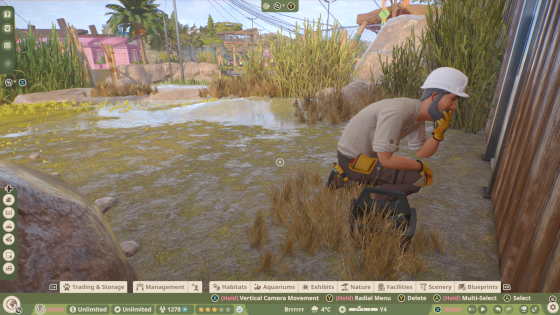
Importantly, a lot of what we love from Planet Zoo remains. You build and manage zoos, create habitats, care for animals, hire staff, educate guests, and try to keep the whole operation financially viable. The sequel expands almost every part of it, from animal behavior and construction tools to conservation, and adds entirely new systems like seasons, aquariums, and aviaries.
Planet Zoo 2 Animals: New Species and Returning Favorites
Planet Zoo 2 launches with a huge selection of new and returning animals to fill traditional habitats and exhibits, along with new aquariums and aviaries. The final launch lineup includes 130 species, with six additional species included in the Deluxe Upgrade Pack. Frontier has also confirmed that Planet Zoo 2 will continue to grow after launch, with more species planned for the future.
There are plenty of familiar animals, including Giant Pandas, Lions, Western Chimpanzees, Red Pandas, Snow Leopards, and Grizzly Bears, but the returning species won’t look the same simply dropped into the new game. Planet Zoo 2 has improved everything from animal fur, feathers, scales, and facial details to movement, breathing, and sounds.
The changes go further than appearance. How animals are built and animated has been refined, with returning species having been given behavioral improvements too. Western Chimpanzees now have improved brachiation, more dynamic jumping, and new interactions with climbing structures, including being able to sleep on them.
Planet Zoo 2 Deluxe Edition: Six Additional Animals
The Deluxe Edition of Planet Zoo 2 includes six additional animals: the Golden Eagle, Golden Lion Tamarin, Axolotl, Great Hammerhead Shark, Blue and Gold Fusilier, and Longfin Batfish, alongside exclusive animal signs. Players who preorder either edition will also receive an interactive tiger photo wall, a Toucan Eat shop with matching signage, and three unique animal donation bins.

Smarter Animals With More Realistic Behavior
Planet Zoo 2 introduces a new behavioral framework called the Animal Brain. Animals still have normal routines, but they now react to their environment, circumstances, and mood rather than repeatedly cycling through the same limited set of actions. An animal’s condition can also be reflected in its behavior. An unhappy tiger may become visibly lethargic, for example, while animals can display more expressive emotions and react more naturally to their surroundings.
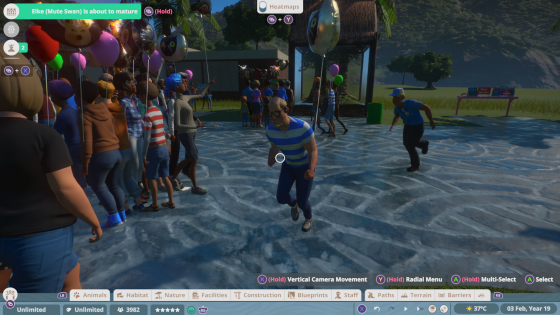
Social animals can also form groups and behave collectively, meaning herds can graze, explore, or rest together, with animals now able to graze from planted vegetation. This isn’t the only environmental interaction to have been expanded. Animals can use climbing structures in a wider variety of ways, react to conditions around them, and physically affect water as they move through it.
Aviaries Bring Flying Birds to Planet Zoo 2
One of Planet Zoo 2’s biggest additions is fully flying birds. Rather than being restricted to walkthrough exhibits, you can now construct customizable aviaries using barriers, adjustable support poles, and dynamic mesh covers. Birds can properly fly, land, perch, and interact with the space above them, meaning enclosure design now has to consider usable airspace as well as ground area.
Planet Zoo 2 Aquariums: Build Underwater Habitats
Fully aquatic animals are a long-awaited addition to Planet Zoo, and we can finally introduce them to our zoos along with completely customizable aquariums. Players can build both freshwater and saltwater environments for species including Blacktip Reef Sharks, Hawksbill Turtles, rays, larger fish, and colorful schools of smaller fish. Some smaller aquatic species can also be housed in exhibits rather than full aquariums.
Aquariums are managed as proper habitats rather than decorative tanks, with water that requires filtration and staff airlocks so keepers can literally suit up to enter the aquarium and care for the animals. Aquarium management has its own infrastructure and staff requirements.
The New Thriving System Takes Animal Welfare Further
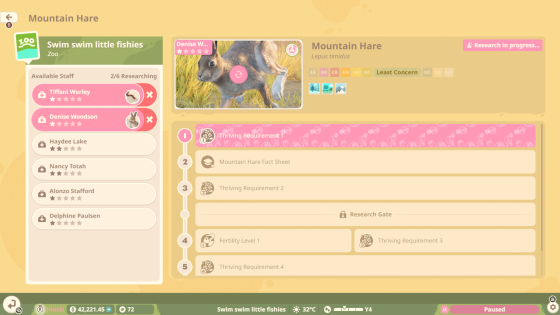
Traditional welfare requirements return, so animals still need suitable space, terrain, plants, food, water, enrichment, and appropriate social conditions. Planet Zoo 2 also introduces a new state beyond traditional welfare requirements called Thriving.
Reaching Thriving status requires research into the species and a habitat that goes beyond its basic welfare needs to provide a more natural and enriching environment. Thriving animals can live longer, with guests encouraged to donate more when they see animals receiving that higher standard of care. Research, habitat design, animal welfare, and zoo finances are therefore more closely connected than they were in the original game.
Building Better Zoos With New Construction Tools
Paths have had a complete overhaul. The new line and curve builder creates a path between two defined points, the draw tool lets you sketch an area and automatically fill it with pathing, the stamp builder creates paths and plazas from preset shapes, and border edit gives much finer control over individual edges. Paths have also been given more customization for colors, railings, and supports. It’s a system that might feel familiar to anyone who has played Planet Coaster 2.
Another big change for building is that scenery pieces can now be scaled and mirrored, and improvements have been made to object selection, grouping, snapping, and surface alignment. That should make detailed construction faster without abandoning the piece-by-piece building system that made the original game so flexible.
Terrain sculpting, stamping, and painting return with new options. Dynamic terrain paints react automatically to slope and elevation, the new curl tool can rotate terrain around the brush into pointed formations, and landscape stamps can quickly create large features such as dunes and rolling hills. A much-requested Nature Brush finally lets you paint foliage and rocks across an area instead of placing everything individually. Live water editing also allows water areas to be reshaped without first deleting the water and rebuilding everything around it.
Four New Scenery Themes
Planet Zoo 2 introduces four new scenery themes, North, South, East, and West, alongside five returning themes from the original game: Planet Zoo, African, East Asia, India, and Classic. These nine themes provide a wide selection of building pieces, decorations, and architectural styles to experiment with when designing your zoos.
Zoo Management Gets a Major Overhaul
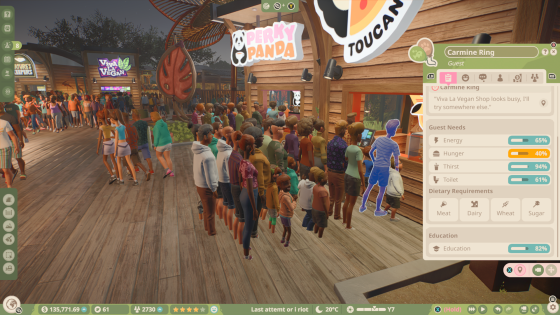
Much of the day-to-day management remains intentionally familiar. Guests still want food, drinks, toilets, places to rest, good views of animals, and opportunities to learn, while unhappy guests may leave early or request refunds. Poor animal welfare can still attract protesters.
Staff roles are familiar too, with caretakers, keepers, mechanics, vendors, vets, and educators all returning. Work Zones remain, along with salaries, training, and staff morale. Zoo finances continue to revolve around admissions, shops, souvenirs, and donations on one side, and construction, salaries, power bills, research, and loans on the other.
One very welcome change is that staff facilities and utilities no longer automatically upset guests simply because they can see them. Now, watching vets and keepers work can actually be part of the visitor experience. Attractive surroundings contribute to guest and staff happiness, but you no longer need to design half your zoo around invisible circles of staff building hatred.
Zoo Reputation has also been overhauled into a five-star rating based on four areas: Animal Husbandry, Sustainability, Guest Education, and Guest Experience. Animal Husbandry includes welfare and Thriving, while Sustainability takes things such as recycling and renewable energy into account.
The Planet Hub Connects Your Zoos and Wildlife Reserves
The Planet Hub is a new management interface for your network of locations. From one place, you can view and visit zoos and Wildlife Reserves, manage animal trading, and coordinate storage and research across locations within your current game mode. The Hub can be opened without returning to the main menu, making separate locations feel more like one connected conservation organization.
Career, Franchise, and Sandbox all return. Career follows FEN, the Fauna and Ecosystems Network, through a worldwide campaign; Franchise lets players build an international network of zoos and reserves while retaining animal trading, and Sandbox continues to provide the most freedom for building and experimentation.
Wildlife Reserves Take Conservation Beyond the Zoo
Wildlife Reserves feel like a look behind the curtain at what happens after animals leave your zoo. Rather than simply sending an animal away and receiving Conservation Credits, Planet Zoo 2 lets players restore expansive Wildlife Reserves around the world before releasing suitable animals into them, turning releasing animals into the wild from a menu action into a playable conservation system.
Establishing reserves will include rebuilding local populations, removing pollutants, dealing with invasive plants, and rebuilding natural environments so that an area is suitable for wildlife. Each reserve contains different ecosystem types, and animals must be released into environments appropriate for them. Reserves will have a minimal staff presence but an extensive research component, with a new Research Vehicle that can be driven around them to explore and observe wildlife. Research conducted through the conservation network can also benefit your wider zoo operation.
Dynamic Seasons Bring New Challenges to Zoo Management
Planet Zoo 2 introduces proper dynamic seasons into zoos and Wildlife Reserves, with the seasonal cycle dependent on the biome and location, so weather will make sense for the part of the world you are building in. The environment changes with the seasons too. Plants can bloom, produce fruit, change color, and lose leaves, while changing temperatures affect animal care. Breeding is now connected to the seasonal system for some species. Animals with seasonal fertility can only conceive during particular parts of the year.
The passage of time has also been slowed considerably. A year in the original Planet Zoo lasted around 18 real-world minutes, while Planet Zoo 2 extends that to 60 minutes.
Planet Zoo 2 PC and Console Requirements
Planet Zoo 2 PC players will need Windows 11, 16GB of RAM, and at least 40GB of SSD storage, with an NVIDIA RTX 2060 or equivalent graphics card as the minimum requirement. The recommended specifications are considerably higher, including an RTX 3070 or equivalent. While Planet Zoo 2 offers the same core gameplay features across PC and consoles, both platforms support mouse and keyboard or controller-based gameplay. One potential difference is the console complexity meter, which limits how much can be built within a zoo. However, it remains to be seen how restrictive this will be.

Cross-Platform Workshop Sharing Comes to Planet Zoo 2
Planet Zoo 2 replaces the split between the Steam Workshop and separate console Frontier Workshop. Creations can now be shared across platforms, with the ability to browse community creations from inside the game, subscribe to blueprints, and place them directly into your zoos.
Capture Your Animals With the New Photo Mode
Planet Zoo 2 also introduces a proper dedicated Photo Mode for both zoos and Wildlife Reserves. It works more like a digital wildlife camera than the standard game view, allowing players to reposition and roll the camera, zoom in, adjust depth of field, exposure, contrast, saturation, and color tint, and remove the interface for clean screenshots. A night-vision filter is also available for photographing animals that are more active after dark.
Planet Zoo 2 Is More Than Planet Zoo With Birds and Fish
Aquariums and aviaries are the obvious headline features, but many of Planet Zoo 2’s most significant improvements affect the systems we will use constantly. Animal behavior is deeper, welfare now extends into Thriving, conservation continues after an animal leaves the zoo, paths and terrain tools have been extensively reworked, seasons influence management, and separate zoos are brought together through the Planet Hub.
For returning players, the animals and systems that return feel substantially different, and personally, I’m excited that the paths might finally stop fighting back.
Planet Zoo 2 Animal List: All Confirmed Species
These are the confirmed animals for the Planet Zoo release, but knowing Frontier, this list won’t take long to expand with new DLCs and update animals.
Terrestrial Habitat Animals
- Aardvark
- African Leopard
- African Penguin
- African Savannah Elephant
- African Wild Dog
- Asian Elephant
- Asian Small-Clawed Otter
- Bactrian Camel
- Binturong
- Black Rhinoceros
- Black Wildebeest
- Blue Wildebeest
- Cape Buffalo
- Common Hippopotamus
- Common Ostrich
- Common Warthog
- Eurasian Beaver
- Eurasian Brown Bear
- Eurasian Lynx
- European Bison
- Galápagos Giant Tortoise
- Gemsbok
- Gharial
- Giant Panda
- Goodfellow’s Tree-Kangaroo
- Grey Wolf
- Grizzly Bear
- Komodo Dragon
- Lion
- Malayan Tapir
- Masai Giraffe
- Meerkat
- Mountain Hare
- Nile Monitor
- North Sulawesi Babirusa
- Nyala
- Plains Zebra
- Przewalski’s Horse
- Red Deer
- Red Panda
- Reticulated Giraffe
- Ring-Tailed Lemur
- Sable Antelope
- Saltwater Crocodile
- Siamang
- Snow Leopard
- Spotted Hyena
- Springbok
- Sumatran Orangutan
- Sumatran Tiger
- Sun Bear
- Sunda Pangolin
- Thomson’s Gazelle
- Western Chimpanzee
- Western Lowland Gorilla
- Wild Boar
Flying Habitat Animals
- Eurasian Bittern
- Great Hornbill
- Greater Flamingo
- Javan Green Magpie
- Long-Eared Owl
- Long-Tailed Parakeet
- Secretarybird
- Shoebill
- Toco Toucan
- White-Backed Vulture
- White-Tailed Sea Eagle
Aquatic Habitat Animals
- African Tigerfish*
- Blackspotted Puffer
- Blacktip Reef Shark
- Bluespine Unicornfish
- Blunthead Cichlid*
- Boeseman’s Rainbowfish*
- Brown Trout*
- Clown Anemonefish*
- Clown Loach
- Clown Triggerfish*
- Common Rudd
- Dolphinfish
- Giant Gourami
- Giant Grouper
- Golden Trevally
- Hawksbill Turtle
- Humphead Wrasse
- Indian Ocean Oriental Sweetlips
- Indo-Pacific Leopard Shark
- Indo-Pacific Sergeant*
- Javanese Cownose Ray
- Ocean Sunfish
- Ocellated Eagle Ray
- Pacific Bluefin Tuna
- Pacific Sardine
- Palette Surgeonfish*
- Red Lionfish
- Sailfin Snapper*
- Sand Tiger Shark
- Schooling Bannerfish*
- Threespot Damselfish
- West Indian Manatee
- Yellow Tang*
- One additional aquatic species (to be announced)
Species marked with an asterisk can be housed in either an aquarium or an exhibit.*
Exhibit Animals
- Amazonian Giant Centipede
- American Bullfrog
- Boa Constrictor
- Cloudless Sulphur
- Common Bluetongue
- Danube Crested Newt
- Desert Horned Viper
- Diamondback Terrapin
- Eastern Brown Snake
- European Peacock
- Fire Salamander
- Giant Forest Scorpion
- Giant Malaysian Leaf Insect
- Giant Slippery Frog
- Giant Tiger Land Snail
- Gila Monster
- Golden Poison Frog
- Goliath Beetle
- Lehmann’s Poison Frog
- Menelaus Blue Morpho
- Mexican Redknee
- Monarch
- Moon Jelly
- Old World Swallowtail
- Red-Eyed Tree Frog
- Sacred Scarab Beetle
- Sri Lankan Rose
- Western Diamondback Rattlesnake
- Yellow Anaconda
Deluxe Edition Animals
- Golden Lion Tamarin
- Golden Eagle
- Great Hammerhead Shark
- Blue and Gold Fusilier
- Longfin Batfish
- Axolotl
Support Unboxed Reviews
Donations are entirely voluntary. Supporters receive no editorial influence — our reviews remain 100% independent.