If you’re a fan of Planet Zoo and considering moving over to Planet Zoo 2, or perhaps you haven’t played either game and you’re wondering which one suits you best, I’m going to cover the biggest differences between the two and whether they’re welcome changes or not.
Having spent over 1,000 hours playing the original Planet Zoo on console, I was incredibly excited to see what the sequel had to offer. And while there are some genuinely impressive improvements, there are also a few changes that have left me wondering why Frontier decided to fix things that weren’t broken. So, is Planet Zoo 2 actually better than the original?
More Animals, but Not Necessarily More Choice
Planet Zoo’s base game has 78 animals, while Planet Zoo 2 has 130 right off the bat, or 136 if you also have the Deluxe Edition. That’s a significant increase, but if you’re years deep into the original Planet Zoo and own every DLC, you may be more accustomed to having around 210 animals to choose from. Suddenly having a much smaller selection of animals to choose from can feel like a huge step backward.
That can be especially irritating when many of the animals you do have are locked behind accreditation tiers, something the original Planet Zoo didn’t implement. In Planet Zoo 2, you need to progress through accreditation levels in both Franchise and Career modes to access more animals, which each have separate progression systems, meaning you can’t simply unlock everything in Career and expect it to be available in Franchise. From my experience, you’re starting with just 32 animals in Franchise or 33 in Career.
The animals that are available are incredible, though. There are returning favorites, such as the Sumatran tiger, alongside new terrestrial additions like Goodfellow’s tree-kangaroo. But the biggest change to the animal selection has to be the introduction of fully aquatic and flying species.
There were birds in the original Planet Zoo, including flamingos, but they couldn’t actually fly. Now they can, alongside new additions such as parakeets and my personal favorite, the shoebill.

Similarly, Planet Zoo had semi-aquatic animals, such as otters and platypuses, but they were housed in traditional habitats. Planet Zoo 2 takes things much further, introducing fully aquatic species, including fish and sharks, that can live in dedicated aquariums.
The animals themselves have also received a major overhaul, both visually and behaviorally. They look considerably more realistic, but it’s the way they move, interact with their surroundings, and respond to one another that really stands out. Animals can now display more natural social behaviors, including flocking, while their animations do a much better job of communicating how they’re feeling.
It’s one of the most impressive improvements in Planet Zoo 2, and it’s clear that an enormous amount of care has gone into making the animals feel more alive.
New Habitats, Aviaries, and Aquariums
As I touched on earlier, Planet Zoo 2 introduces flying birds and fully aquatic species, so naturally, some of the biggest changes to habitats come as a result of that.
Flying birds need an enclosed space, so the game now includes the option to add a roof to an existing habitat. This can also be used for terrestrial animals, giving you more flexibility when designing all habitats. Aside from that, building an aviary isn’t dramatically different from building any other habitat.
Aquariums follow a similar principle, although there are a few additional considerations. They require appropriate underwater access for keepers, and maintaining them involves managing water conditions, including salinity.
Exhibits have also received a welcome improvement. They’re now available in a wider range of shapes and sizes, with much more customization than before. Some aquatic species can even be housed in either aquariums or exhibits, giving you more flexibility over how you display them.

The basic principles of building traditional habitats remain familiar. You still construct barriers using your preferred materials, adjust their lengths and heights, and design the space around the needs of your animals.
The biggest differences are the additional building options and the way certain animal requirements have changed. For example, shelter for some flying species can involve bird boxes rather than the traditional shelters we’re used to. Overall, the new habitat options are a welcome addition, although they’re more of an expansion of the existing system than a complete reinvention.
A Complete Overhaul of Paths and Landscaping
Paths and landscaping have received such a huge overhaul that, so far, they’ve been both my favorite improvement and the thing that has driven me closest to insanity. Hopefully, a lot of that frustration will disappear as I get used to the new tools.
There are so many more options for both paths and terrain that you have considerably more control over your zoo’s appearance. The interaction between paths and landscaping is also much easier to manage once you get the hang of it.
Paths can now be customized in almost every way imaginable. You can still choose your preferred material, but you can now change its color too, along with the railings, curbs, and their colors.
Laying paths feels much more intuitive, and getting different sections to connect is considerably easier than it was in Planet Zoo. There are also new options for filling entire areas with paths, allowing you to create large plazas and wider, more interestingly shaped walkways without having to fight the building system.

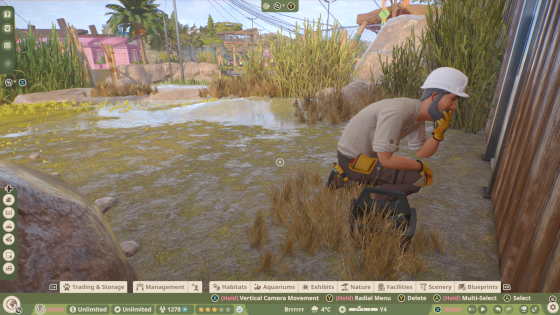
Paths no longer seem determined to go to war with every barrier or body of water they encounter, either. It’s much easier to trim away unwanted sections when your path ends up on the wrong side of a barrier. I still haven’t worked out how to reliably create stairs instead of slopes, though. I’ll keep you updated on that one.
There’s also the entirely new addition of tunnels, primarily for use as walkthroughs for aquariums. However, as they’re essentially enclosed paths, they can also be used elsewhere throughout your zoo.
Terrain editing has received a similarly impressive overhaul, with new tools allowing for much more natural landscapes and greater control over dips, slopes and edges. The Nature Brush tools are another welcome addition, making it easier to create natural-looking environments without having to place every individual plant or rock yourself.
There’s a huge variety of new tools to sink your teeth into, and I suspect they’ll become even more enjoyable as I get used to them. I do, however, keep finding that when I tell the terrain to push, it pulls instead, because there’s a button that switches between the two functions. Useful when you mean to do it. Not so useful when you don’t.
But that’s not really a reflection of the tools themselves, which are genuinely excellent. It’s more about the menus and controls, which bring me to my biggest gripe with Planet Zoo 2.
More Complicated Menus and Animal Management
The menus – there are so many now; there are two main ones on the play screen, and then within every selection it feels like you’re opening another smaller menu. I feel like Frontier has overcomplicated things that didn’t need changing while missing opportunities to make genuinely useful improvements.
The bottom menu separates habitats and aquariums, despite them sharing most of the same basic principles. Exhibits also have their own section, which feels unnecessary when these could have been grouped together more efficiently. All harmless but unnecessary changes, especially when I can only assume, due to a lack of space, we now have to navigate two separate menus.
And the game doesn’t like you staying in the section you’re in either. For example, when you’re in the habitat menu, selecting barriers takes you to an entirely different menu. I understand why barriers have their own category, as they always did in the original game, but having the option appear in one menu only to send you somewhere else seems unnecessarily complicated. It’s particularly frustrating when you then have to navigate back to where you started.
The additional filters for essential items are another irritation when you’re first starting out, as is the fact that blueprints aren’t displayed by default. Unless you know to enable these options, it can feel like there’s considerably less content available than there actually is.
Animal management has also become more frustrating. It now takes longer to move between your stored animals, the animal market, and the animals already living in your zoo, making it really frustrating when you forget for the third time whether the panda you already have is male or female while trying to find it a mate. I don’t understand why these features needed separating.
I also haven’t found a way to see where an animal was born, which is disappointing. I like knowing which of my animals were bred in my own zoo rather than purchased from elsewhere. Changing food quality has also become a multistep process, requiring you to navigate between different menus for individual animals.
Adopting animals is similarly frustrating. Instead of quickly selecting the animals you want, you now have to open an animal’s details, navigate to the adoption option, and then return to the market. That’s not too bad when you’re adopting one bear, but when you’re trying to buy 20 flamingos, it gets old very quickly.
The animal market itself is also worth mentioning. In the original Planet Zoo, animal availability was dependent on the game mode, but most animals could be or become available. Planet Zoo 2 adds accreditation requirements to Career and Franchise, meaning your choice of animals is restricted by progression as well as what’s currently available through the market. For players who prefer to build one zoo slowly and thoroughly, having to create additional zoos to progress, something required to progress your accreditation to unlock animals could be particularly frustrating.
And I cannot for the life of me work out where the automated population management option has gone for exhibit animals. This was such a useful feature in the original Planet Zoo, allowing you to automatically manage breeding populations without constantly checking every exhibit. If it’s genuinely been removed rather than relocated, I will be stomping my foot. I understand wanting the sequel to feel more involved and realistic, but manually managing these things was always an option. Taking away the choice would feel like a step backward.
Improved Building Tools, Frustrating Controls
Speaking specifically as an Xbox player, I find the controls particularly disappointing. The original Planet Zoo was designed for PC and later adapted for consoles, while Planet Zoo 2 was developed with both PC and console players in mind.
Yet somehow, I found the original much more user-friendly on an Xbox Series X. I feel like I spend considerably more time navigating menus than I ever did before. Pressing B no longer takes you back through the previous submenu. Instead, it closes the menu entirely.
Another huge gripe is the Demolition button. It’s positioned where you can accidentally reach it by pressing one button too many, and simply highlighting it switches you to another menu screen, leaving you to navigate back to whatever you were trying to do.
Controls such as path width are now hidden behind additional drop-down menus, and leaving those menus open prevents you from using the tool. This means creating a path with varying widths becomes an exercise in opening the menu, changing the size, closing the menu, drawing the path, and then repeating the entire process.
Having what essentially feels like two separate menus competing for your attention is equally frustrating. You can press A expecting to open animal trading because that’s what’s selected at the bottom, only to accidentally open pathing because that was also selected in the side menu.
Overall, I think the original Planet Zoo was considerably more player-friendly. Planet Zoo 2 has rearranged menus that worked perfectly well, added unnecessary steps to simple tasks, separated features that belong together, and introduced shortcuts that often become long cuts when you activate them accidentally.
The new building tools are fantastic, but accessing and using them shouldn’t feel like such hard work. Also, how many hours do I need to play before I stop pressing the View button on my controller and accidentally coming out of the game? Because apparently, I haven’t reached that point yet.
Career Mode and the New Accreditation System
Career mode in the original Planet Zoo was essentially a collection of largely self-contained scenarios. You completed objectives to earn bronze, silver, or gold medals, and once you’d finished a zoo, you could move on without worrying about it again, with mini-games within the game.
Planet Zoo 2 follows a similar concept, but this time there’s a greater sense of progression between locations. Completing scenarios unlocks new ones, and the different locations are connected through the game’s wider conservation objectives.
For example, one zoo might help prepare animals that you’ll later need to release into a Wildlife Reserve. The accreditation system also plays a much bigger role in your progression. Rather than simply completing individual scenarios, you’re working toward accreditation tiers that unlock additional animals, facilities and other opportunities.

Career progression is largely tied to completing objectives and earning medals, while Franchise mode uses its own accreditation requirements based on developing and improving your zoos.
This gives the game a more connected progression system, although it also means you don’t necessarily have access to all the animals you want when you first start playing. Whether that’s an improvement will probably depend on how much you enjoy having things to unlock.
Personally, I can see the appeal of having more progression, but I also find it frustrating when I know exactly which animals I want to build for and can’t access them yet.
Wildlife Reserves Bring Conservation to Life
One of the biggest additions to Planet Zoo 2 is Wildlife Reserves, which take the conservation side of the game beyond simply breeding animals and releasing them into the “wild,” which was essentially a more feel-good version of deleting them.
Instead of your animals disappearing into the great unknown when they’re released, you can now send them to reserves that you’re responsible for helping to restore and maintain. These reserves aren’t traditional zoos. You’re not building shops, restaurants and guest attractions to generate income. There are no barriers, no staff and no visitors.
Instead, the focus is on restoring natural environments and creating suitable ecosystems for wildlife. That can involve removing pollution, dealing with invasive plants, improving the landscape and ensuring the environment can support the animals you intend to release.

You can explore the reserves using a vehicle or traveling on foot to observe wildlife and take photographs. It’s a lovely idea, and I appreciate the attempt to make conservation feel like something more meaningful than clicking a button to release an animal. However, I do feel the reserves are a little underwhelming in practice.
While there’s some satisfaction in restoring an environment and seeing animals released into it, the actual gameplay isn’t particularly extensive, and the menus and controls are again a little confusing.
I like the concept, and it’s a welcome addition to the game, but I wouldn’t say Wildlife Reserves alone are enough to justify moving from Planet Zoo to Planet Zoo 2. They’re a nice extension of the conservation system rather than an entirely new game within the game.
Animal Welfare Goes Beyond Happiness
Animal welfare has always been central to Planet Zoo, but Planet Zoo 2 takes it a step further with the new Thriving system. In the original game, the goal was largely to keep your animals happy and healthy by meeting their needs for food, space, enrichment and suitable social groups.
Those requirements are still important, but Planet Zoo 2 introduces a higher standard of care. Rather than simply ensuring an animal has acceptable welfare, you can work toward helping it thrive. Thriving animals can live longer and contribute to greater donations, while the system also connects with the game’s wider conservation and release objectives.

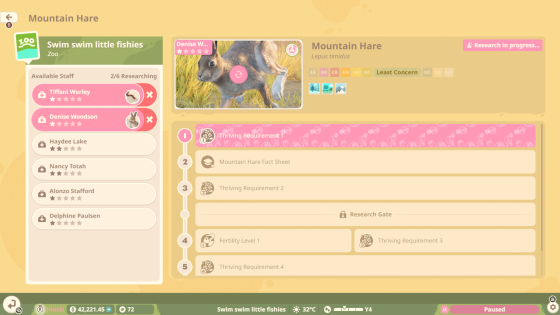
I actually think this is a welcome change. It gives you more reason to focus on the animals themselves rather than simply building an enclosure, filling it with enrichment and moving on to the next species. It also makes the development of your zoo a more ongoing process, with research required to establish the needs that help them thrive.
Fewer Building Restrictions
One thing I particularly appreciate about Planet Zoo 2 is that building feels considerably more flexible. There are things you can do in the sequel that were difficult or impossible in the original game. Paths and barriers can interact in ways that give you more freedom, and shops and exhibits can now be incorporated directly onto paved areas.
Staff facilities also feel less restrictive. You can place keeper huts much more prominently without worrying about guests becoming upset simply because they’ve spotted a member of staff doing their job. Apparently, guests have finally learned that someone actually needs to look after the animals.
You can now scale up or down the majority of things, scenery and plants, well, you should be able to. At the moment scaling things up seems to just move the parts of it further apart, but I have my fingers crossed that’s just a bug; it does seem to work on plants for me though, so I can have my mushrooms. (Maybe the entire answer to what has changed should have been: there are now adorable mushrooms!), as big or as small as I like.
These might sound like small changes, but they make a huge difference when you’re designing a zoo. The original Planet Zoo could be incredibly restrictive when it came to placing certain objects, particularly when paths, barriers and facilities needed to interact. Planet Zoo 2 gives you much more freedom to create the zoo you actually want rather than constantly working around the limitations of the building system.
Changes to Staff and Research
There have also been some notable changes to staff and research in Planet Zoo 2.
Security
One of the first things I noticed was the apparent absence of security guards. In the original Planet Zoo, you needed security staff to deal with pickpockets and vandalism, adding another layer to managing your guests. So far, I haven’t encountered the same crime management in Planet Zoo 2. It doesn’t have a particularly significant impact on playing the game, but it’s an interesting change if the feature has been removed entirely.
Mechanics and Workshops
The original Planet Zoo also required mechanics to conduct research in workshops, gradually unlocking new building themes, decorations, barriers and other construction options. That familiar workshop research system appears to have been removed in Planet Zoo 2. Personally, I don’t mind this. Having to research building pieces could be frustrating when you already knew what you wanted to create, particularly when starting a new zoo.
Research
Animal research is still important, but the way it’s organized has changed. In Planet Zoo, researching individual species improved your knowledge of them and unlocked additional enrichment options.
Planet Zoo 2 separates research into more distinct categories, including species, enrichment, education, and diseases. This gives you more control over what you’re researching, although it also means there are more systems to manage. Research also connects with Wildlife Reserves, allowing the knowledge gained through conservation work to contribute to your wider progression.
A More Detailed Marketing System
Marketing has also changed considerably. In the original Planet Zoo, marketing was relatively straightforward. You selected a campaign based on its cost and effectiveness, and it helped attract more guests to your zoo.
Planet Zoo 2 introduces a more involved system. You first need to unlock marketing slots through accreditation, and campaigns can then focus on specific animals rather than simply advertising the zoo as a whole.
Further progression unlocks additional marketing opportunities and improvements. I can understand the idea behind this, but I don’t particularly like the way it’s presented.
The pictures beside the animals’ names aren’t always especially clear, and the name is all you have to go off, not the species. So if I want to advertise a tiger, I have to take myself off to the animal menu to check what my tiger is called before I’m able to start the campaign. It’s another feature that adds more detail but also more steps to something that was previously very simple.
Guests Have More Individual Needs
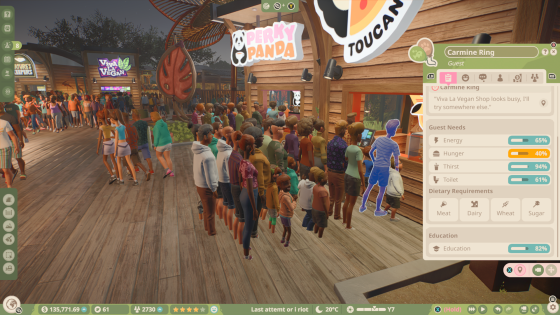
Guest welfare also seems to have become more involved in Planet Zoo 2. Guests now have additional preferences and dietary requirements, including allergies, which you need to consider when choosing food and drink options. It’s a relatively small change compared with the new animals and building tools, but it contributes to the sequel’s more detailed management systems.
Conservation Projects Add Another Progression System
Another addition is Conservation Projects, although I think the name makes them sound considerably more exciting than they actually are. Unlike Wildlife Reserves, these aren’t locations you can actively explore and develop.
Instead, they involve allocating resources, such as money, Conservation Credits or staff, toward conservation initiatives. You receive progression or other benefits in return, but there’s no direct interaction involved.
Cross-Platform Sharing Through the Frontier Workshop
Another important change is the move toward the Frontier Workshop. As an Xbox player, this hasn’t affected me as much as it might affect someone who played the original Planet Zoo on PC.
The Workshop experience is still very familiar to me, although the layout has changed. The biggest improvement is that creations can now be shared across platforms, meaning console players can access designs uploaded by PC players too.
I’m less sure how PC players feel about the move away from the original Steam Workshop system. Other games have received considerable criticism for similar changes, particularly when players already have large collections of community creations.
So, Is Planet Zoo 2 Better Than Planet Zoo?
Ultimately, the ethos of Planet Zoo remains unchanged. Animal care and conservation are still at the heart of the experience, and the aim is still to build and manage successful zoos while keeping your animals, guests and staff happy. Even the basic gameplay remains familiar. You build habitats, create paths, research animals and gradually expand your zoo. The biggest changes are in how you do those things.
And to be fair, a lot of the changes are genuinely excellent. The new animals are incredible, particularly the fully aquatic and flying species. The visual improvements and more natural behaviors make watching them an absolute joy. The changes to paths, landscaping, and building flexibility are also fantastic, giving players much more freedom to create detailed and realistic zoos. Wildlife Reserves are a welcome addition to the conservation side of the game, even if I don’t think there’s quite enough to them yet.
It’s clear that an enormous amount of thought and effort has gone into improving the animals and creative tools. Unfortunately, I don’t think the same can be said for the overall usability. The menus feel unnecessarily complicated, with features scattered across different sections and additional steps required for tasks that were much simpler in the original game. As an Xbox player, I find this particularly frustrating because Planet Zoo’s console controls were genuinely good.
Planet Zoo 2 might offer considerably better building tools, but having to fight the menus every time I want to use them takes some of the enjoyment away. And that’s really where I think the biggest difference lies. Planet Zoo 2 gives me more freedom to create the zoo I want, but Planet Zoo makes the process of actually playing the game feel easier.
I’m really enjoying Planet Zoo 2, and I can still lose hours building habitats, experimenting with the new tools and watching the animals. But when I’m ready to switch off and settle into my comfort game, I’m still going back to the original Planet Zoo.
That, combined with the significant number of launch bugs that players have reported, leaves me wondering whether more extensive player testing should have taken place before release. Paying full price for a game only to feel like you’re helping test it leaves a bit of a bitter taste in my mouth.
So, Which Should I Play?
If you’ve spent years playing Planet Zoo, have done everything you want to do and are ready for a new challenge, Planet Zoo 2 is absolutely worth considering. The aquariums, aviaries, improved animals and creative tools offer plenty of reasons to return.
But if you’re completely new to the series and trying to decide which game to buy first, I would still recommend the original Planet Zoo. It might not have all the new features, but it offers an enormous amount of content, particularly with its DLC, and I think it’s currently the more enjoyable game to actually play.
Of course, the original Planet Zoo has also benefited from years of updates and additional content, while Planet Zoo 2 has only just launched. Maybe in a couple of months, once Frontier has had time to respond to player feedback, improve the controls and menus, and resolve the launch issues, my opinion will change. I genuinely hope it does, because there’s an incredible game underneath some very frustrating design decisions. But for now, if you’re on the fence, I would say Planet Zoo still wins.
Frequently Asked Questions
Do you need Planet Zoo to play Planet Zoo 2?
Where can you buy Planet Zoo and Planet Zoo 2?
Can you buy DLC for Planet Zoo and Planet Zoo 2?
Does Planet Zoo 2 have timed scenarios?
Can you transfer your zoos from Planet Zoo to Planet Zoo 2?
Can you play Planet Zoo 2 offline?
Support Unboxed Reviews
Donations are entirely voluntary. Supporters receive no editorial influence — our reviews remain 100% independent.